
“You can never be reminded enough to spend time listening to other people”: Why listening is a parent’s greatest superpower

With over 35,000 families in their network, Parents for Future UK is one of the largest climate movements in the UK and was one of the first organisations to take part in Let’s Talk Climate training.
Here, Co-Director, Lucie Brown, sets out why she believes in the power of climate conversations, why it can be much harder to talk to your neighbour than to a politician, and how the training has helped parents speak up for their children’s futures.
From school strikes to front rooms
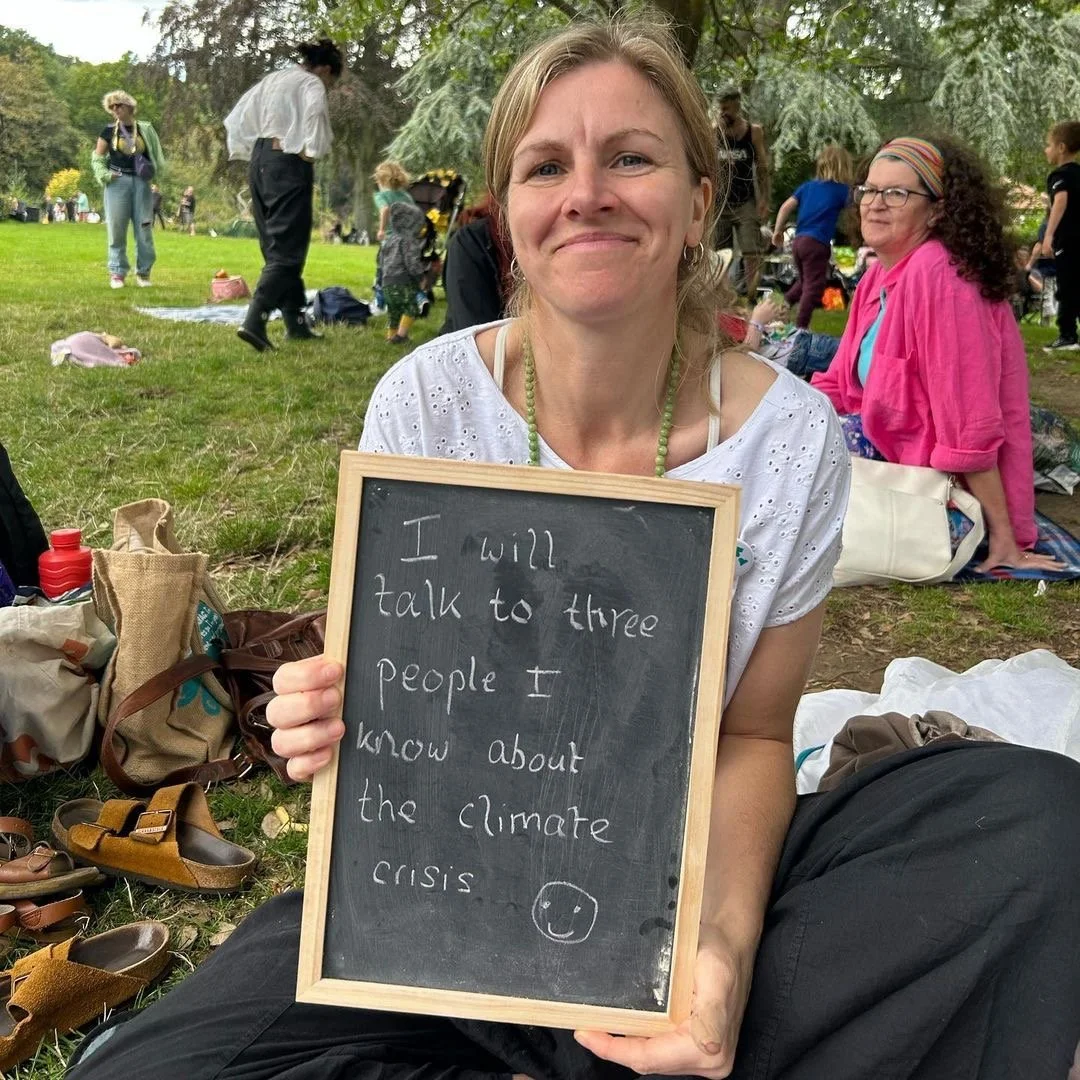
Lucie Brown, Parents For Future
Parents For Future grew out of the school climate strikes that made headlines in 2019 - Greta Thunberg was inspiring children all over the world to think more about the climate crisis but it couldn’t be just down to the next generation to take on this responsibility.
PFF formed to inspire and engage more adults to join the climate movement because the crisis will impact all children across the globe and because parents could have incredible power if we worked together.
What started as just a small group of mums has now become a national network of more than 35,000 members, supported by 36 local groups across England and Wales and a thriving online community.
A safe space for parent power
Initially, a lot of our members were part of movements like Extinction Rebellion and while we do still have a lot of those experienced activists, a larger percentage are people who are completely new to politics and community work but have had kids and realised they want to help make a difference for them.
Although we’re a climate justice movement, we’ve always been very intersectional, meaning we look at systemic root causes and how climate breakdown affects different communities in unequal ways. We provide a lot of training and support around anti-oppression and are proud to have a really strong culture of care. We want to provide a safe space for the parents and carers who are involved in our movement, wherever they are on their journey.
Why communication is the key
Communication is a vital part of building our community and creating a powerful parent voice, so when we heard about Larger Us’ pilot Let’s Talk Climate programme we were keen to get involved.
With polarisation on the rise, I think anything that improves communication is to be welcomed. We all need more connection in our lives, and within the communities we live in, so it’s crucial to have the tools to do that. The conversations you have with someone might just be the thing that sparks them to start questioning false news or misinformation.
The first pilot in 2023 was run within our community, swiftly followed by two more which incorporated our feedback. In total, 165 of our members have now taken part in the training.
It’s important because we can’t assume that people are having climate conversations, even in an organisation like ours. It can actually be really scary to have these interactions, particularly with people you know. It’s often a lot easier to be campaigning at external targets than it is to talk to a postal worker or your father-in-law, because they're quite daunting conversations to have.
And, actually, the more you learn and the more you engage in activism, the more passion you feel so that can make it even harder to broach those conversations with people who you see regularly because you worry about being the person who brings the mood down or causes arguments or conflict.
There was a real recognition within Parents for Future that people needed support to have those conversations. People wanted to talk but they were finding it hard and were keen to find a way to do it better.
“We can’t assume that people are having climate conversations, even in an organisation like ours. It can actually be really scary to have these interactions, particularly with people you know. It’s often a lot easier to be campaigning at external targets than it is to talk to a postal worker or your father-in-law.”
The biggest takeaway: you don't have to ‘win’
Before working with Larger Us, we’d been focused on things like inclusive facilitation, finding accessible ways to deliver information and tackling misinformation. We looked at the facts and how to understand and include more people in the conversation, but we hadn’t looked at the tools and techniques of how to have the conversation.
From the very beginning, the main learning that we took away was that you don't need to go into a conversation thinking your goal is to win an argument.
That was consistently the feedback - every conversation is helpful and listening and learning to the other person's perspective is really important and valuable.
That approach is so effective because it takes the pressure off and stops you walking away feeling like the conversation was a failure, which is what we’re often prone to doing, and so it inspires you to be brave and have more of them.
You can never be reminded enough to spend time listening to other people.
Keeping the momentum going
We’ve participated in three rounds of Let’s Talk Climate and we’ve learned the importance of planning for when the training has ended. It can’t just be a case of ‘right, we’ve done the training, off you go…’. There needs to be ongoing support, a space for people to come back and land in, share what’s gone well, what challenges they had, and to inspire each other going forwards.
We’ve created that space in our own community and it’s a really important thing for anyone else taking part in the training to think about. These conversations definitely work best when there is a community to embed them into.
The structure of the training, where people met regularly and built relationships with each other, was key to the success of it. Having our online community space, where we've continued to share learnings and talk about things, has kept it alive, not just for those who took the training but for others too. In fact, just in the last few weeks, one of the training participants has asked if she can start running climate conversation sessions within our movement off the back of what she learned.
The fact it’s continuing is really positive feedback. I know so many of our members got so much from it and it continues to impact the way they communicate around climate today.