
The impact of a great conversation - how and why they capture hearts and minds
We’ve known for a long time now that conversations are one of the greatest tools in our armoury when it comes to bringing about social change.
They’re at the very heart of our Let’s Talk Climate programme.
But how and why do they work? Our report, Let’s Talk, is a deep dive into the science behind the theory, bringing together academic research and examples of where conversations have had, and are continuing to have, a powerful impact.
In this article, which draws on some of the findings from the report, we’ll be taking a look at what exactly happens in our brains when we’re involved in a great conversation and the chain reaction this causes in ourselves and wider society.
What is the Chain of Impact and how is it activated?
We’ve coined the term Chain of Impact to describe what happens during and after a productive conversation. It details a series of mechanisms (see table below) that are activated by a high quality discussion and may ultimately lead a person to change their attitudes or behaviours.For example, if someone feels like they are being listened to this can trigger a greater sense of psychological safety or if they’re encouraged that their actions can really make a difference they’ll feel an increased sense of efficacy, or confidence, to go out and take that action.
What constitutes a great conversation?
Crucially, our research found that conversations that are effective at shifting attitudes, norms and behaviours all contain certain elements that make it easier for people to build genuine connection and respond to what is being said.These kinds of conversations rarely happen by accident and usually contain a combination of six key attributes.
Non-judgemental raising of an issue
High-quality listening
Consensus-building and finding common ground
Framing your message in alignment with people’s values
The opportunity to exchange views and experiences
Efficacy-building and commitment-making
Not all conversations need to include all six attributes to be effective, but the more of them that feature, the more of the following mechanisms are likely to be activated.
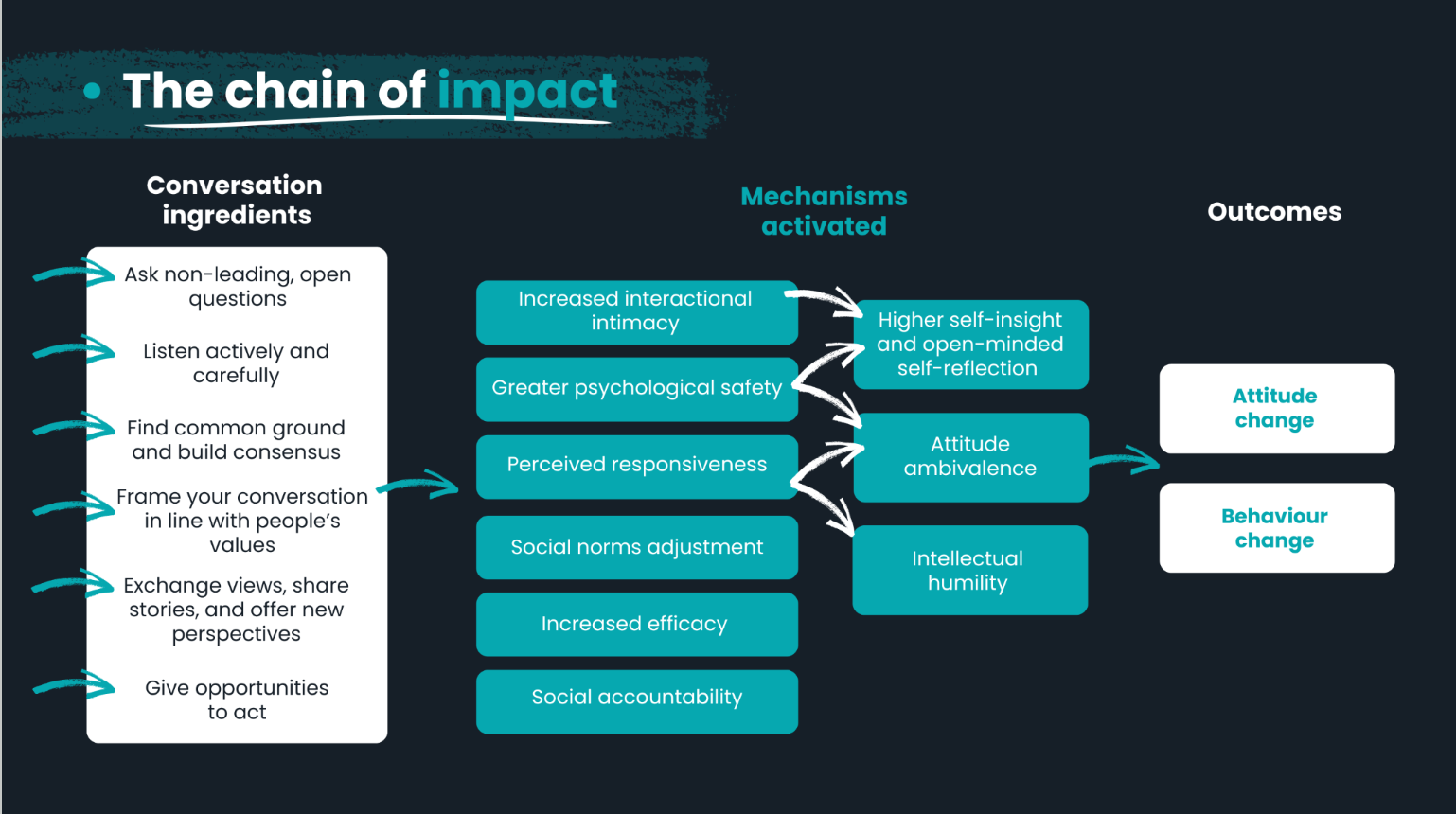
The magic mechanisms activated by a great chat
As you can see from the diagram above, there are nine key interchangeable mechanisms that can be triggered by a good conversation.
The initial six are:
Increased interactional intimacy: Sharing stories, views and experience in a non-judgemental space helps us feel closer to the people we are talking to, and more likely to open our minds to what they have to say.
Greater psychological safety: When we really feel listened to it helps us feel safer and to lower our guard, inviting more self-reflection and an openness to changing our mind.
Perceived responsiveness: Feeling heard and understood by the other person helps us see that our words, opinions and values are valid and of consequence.
Social norms adjustment: This is about breaking what’s known as the ‘spiral of silence’ that may inhibit us from sharing our views when we believe we’re in the minority. When others fail to share their views it can lead us to assume that they feel a certain way when perhaps they don’t. Conversations help close this gap between norms on what we should do and what we see people actually do.
Increased efficacy: Good conversations help break down people’s beliefs that they – or wider society - are powerless to do anything that will enact change. Receiving support from others can lead to a higher intention to take action by fostering hope.
Social accountability: Supportive conversations make it easier to publicly commit to change and to work to fulfil that, knowing that failing to achieve it won’t result in any threat to us, such as social exclusion.
The presence of these six mechanisms can then lead to three further mechanisms, which then flow directly into changes in attitudes and behaviours.
Higher self-insight and open-minded self-reflection: A greater understanding of why we might hold the views we do, and how much they might be influenced by external factors, rather than being our own deeply-held opinion.
Attitude ambivalence: Loosening the conviction with which we hold views on certain topics.
Intellectual humility: Remaining open to the idea that we might be wrong about a topic and being willing to process new information to adjust our views.
The report demonstrates this in a number of real-life case studies which show the Chain of Impact in action. For example:
Who is Your Neighbour? – A South Yorkshire-based charity that holds small, facilitated group conversations with communities around challenges they feel they’re facing in their local area. This ranges from things like industrial decline to the integration of newcomers into the community. By creating a non-judgemental space where people can ask curious questions, members are encouraged to build self-insight and reflect, often leading to a reduction in the conviction with which they hold certain views (attitude ambivalence).
Climate for Change (C4C) – Run by the Scottish Communities Climate Action Network (SCCAN), this initiative consists of a Tupperware party-style model, where trained volunteers invite family, friends and neighbours to their homes or other trusted space to talk about climate issues. It’s led to a social norms adjustment by normalising pro-climate attitudes and behaviours within people’s social networks. Sessions aim to end with commitment making, building collective efficacy and creating social accountability.
More than talking
So, what does all this teach us?
It certainly reinforces what we already knew – that conversations are a fundamental tool in changing hearts and minds.
But, more than that, it’s about the quality of those conversations and the way in which they take place.
Effective conversations are not a one-way broadcast. However passionately you may feel about something, dispensing your advice and then disappearing is not likely to lead to change. Change comes about when people feel listened to, safe, supported and that the action they’re going to take will make a real difference.
If we want to change the world with a chat, creating the enabling conditions, both within and between people, is vital to making that happen.
To find out more, you can read the full report here.