
‘We needed more than a sticker’: lessons from the Greenpeace climate conversations campaign
They’ve been campaigning on climate since the 1970s but now Greenpeace is introducing a new strand to their work - encouraging their supporters to have climate conversations. Not just with politicians or CEOs, but people they actually know.
Organiser Nikki Gommers shares the highs and hurdles of 2025’s Chats for Change campaign and the surprisingly hard reality of talking to the people we love.
A conversation with Nikki Gommers
Why did you choose conversations?
Chats for Change came on the back of an action we took outside Shell’s London HQ where we used large glass cases to display items from family homes in the Philippines that had been destroyed by fossil fuelled typhoons. Every single object had a powerful story - from a much-loved cuddly toy to a well-worn sofa - all humanised the cost of climate destruction driven by oil giants like Shell, and we wanted our campaign to capture that same emotion through storytelling.
It can be quite a stretch for people to make the connection between the damage caused by climate change and who has to pay for it, so we knew the follow-up campaign needed to be deeper than just producing some stickers and asking people to distribute them.
We wanted to reach audiences we don’t normally engage with and were very keen to explore the power of conversations. I knew from my previous work in politics in the Netherlands that relational conversations are a powerful tactic. If people are unsure if they agree with something they are much more likely to change their opinion if they receive information from someone they trust like a friend or family member.
It was the first time Greenpeace tried the approach. We’ve had conversations on doorsteps and while out on stalls but the conversations with friends and family element was new.
What went well?
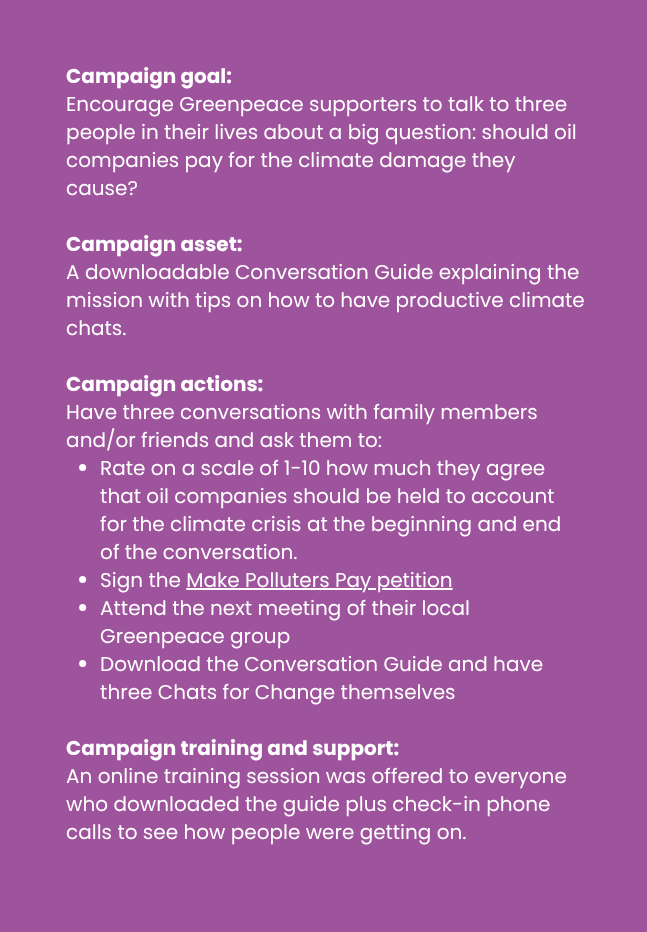
We proved that climate conversations really do have power: Over 1,400 people downloaded the guide and, of those we followed up with via phone call, 21% had had at least one climate conversation. Several reported that their conversations successfully moved people up the 1-10 scale (of whether oil companies should be held accountable) and, while the average movement was modest (0.92), it demonstrates that changing minds through conversation is possible.
Training sessions were a vital confidence boost: Ninety people signed up for the online training session which focused on storytelling skills and gave people a framework they could use in their conversations, helping them focus on values rather than facts. We also talked about the art of the ‘hard ask’ and gave people the opportunity to practice in breakout rooms.
Many of those who came along were existing volunteers but they reported feeling a lot more confident following the sessions. Participants later gave us examples of how they’d used current events in their community – for example, flooding in Wales – to anchor their conversations, using what they’d learned about shared values and experiences.We reached new audiences: While many of those that came to the training were already our supporters there were some who’d never engaged with us before. We can’t be sure exactly how many conversations were initiated, but we know that chats were held with people who may never have come across our work before.
What lessons were learned?
Talking to friends and family was a harder ask than we expected: One of our goals was for 20% of the people who downloaded the guide to report back on having conversations – only 7% actually did. Many volunteers found talking to loved ones harder than talking to strangers. I think this is because it potentially involves more of a risk of rejection. If a stranger doesn’t want to talk to you while you’re out on a stall that’s easier to deal with than if a friend or family member doesn’t want to engage with something you’re really passionate about. For lots of our volunteers Greenpeace is a part of their identity.
On reflection, because these conversations are quite a transformative ask, a more structured, longer-term approach might work better than a one-off challenge. If the goal is really to change minds, then it starts with listening and that’s hard to do in one conversation. Building trust, building community, building relationships takes time.
Time frames and structure are crucial: Although the campaign was linked to the action at Shell HQ, there was no real urgency or time frame for having the conversations which made it easier for people to give up, or not do it at all. This lack of a clear expectation acted as a barrier as it felt too open-ended. Asking people to commit to something for a set period of time - say six weeks like the Let’s Talk Climate programme – means people know exactly what they’re signing up for, making it feel more achievable.
Get the training element in up front: The success of the training sessions made us realise that people really responded to that support and guidance, but it would have been good if more people had been able to access it.
In future campaigns I would look to introduce a training element right at the start – for example a one-hour workshop or webinar where you make the case for why conversations are so powerful and really help people get in the right mindset to do it without them needing to commit to a training session at that stage.
Less persuading, more listening: The initiative was very persuasion-focused, as were the communications around it. We talked a lot about the action at Shell HQ and the campaign itself, rather than exploring the effectiveness of conversations and how much of an impact they could have. We could have focused more on the idea of active listening and demonstrating the difference this can make, which would have given them more of a sense of efficacy and the feeling that their actions really were worthwhile.
If you want to learn more, here’s the Greenpeace Chats for Change conversation guide.